


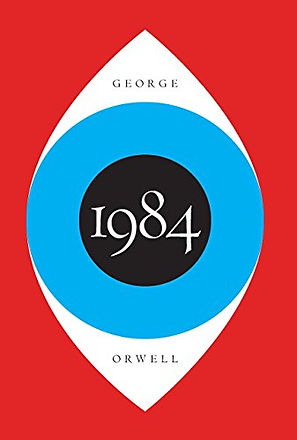
1984
By: George Orwell
REVIEW BY: TYLER BOYLE
George Orwell’s dystopian novel, 1984, published in 1949 shortly after the fall of Nazi Germany and the rise of the communist Soviet Union, frighteningly depicts a future that society seems quickly headed for. The novel follows the protagonist, Winston Smith, living in London, England over the roughly 40 year old Oceana party/government in 1984. The party, headed by a figure known as, “Big Brother,” controls a world where every citizen is watches, listens to, and analyzes at all times. Oceana also promotes strategies like, “newspeak,” a newly invented language meant to eliminate words and thoughts that could threaten or undermine the party. One of these new words is, “thoughtcrime,” in which a person's thoughts were subject to persecution if thought to be against the party. This created a society in which people would refuse to hold negative or critical beliefs about the party. In addition, Oceana and Big Brother utilize ceremonies and rituals of propaganda to form the opinions and minds of the people of the party. The party’s three most important pieces of propaganda is their slogan: WAR IS PEACE, FREEDOM IS SLAVERY, IGNORANCE IS STRENGTH. This resulted in the party promoting the act of, “doublethink,” or being able to truly believe in a false reality even though one has the facts to disprove the false reality. Winston and his newly found lover, Julia, over the course of the novel try to rebel against the party as they loath the party’s controlling and propagandized leadership styles.
The surveillance society portrayed by Orwell in the novel is becoming strikingly more prevalent in today’s world. However, opposed to a government utilizing surveillance powers, Silicon Valley, big tech, and capitalism has exploited the tactic even more than government. This is due to the rise of technology companies like Google, Facebook, Twitter, and Tik Tok who use their data gathering and analytics tools that invade one’s privacy. By collecting this data they are able to predict and influence one’s behavior to sell to 3rd party business partners. This is the same type of surveillance and use of misinformation to form people’s thoughts and opinions for them in 1984. This phenom is prevalent when Winston analyzes the talk and action from one of his neighbors when he thinks to himself, “She had not a thought in her head that was not a slogan, and there was no imbecility, absolutely none, that she was not capable of swallowing if the Party handed it out to her” (67). This same type of hypnosis occurs into today’s world with social media. Most of the thoughts formed by people are thoughts imposed on them by the behavioral control of the algorithms of the social platforms in order to simply get one addicted to the app, so the technology companies earn more money, thus more power. The purpose is not to promote truth, a unifying message, or good morals, but for power.
In addition, 1984’s idea of “doublethink” is an act very prominent in today’s ignorant and confirmation biased society. In the novel, the party often promotes the idea on citizens 2+2=5 even when evidence says otherwise. Instead of citizens denying this belief, due to their loyalty and reverence for the party, created through propaganda and some instances torture, the people recognize the falsehood as truth. The phenomena, “doublethink,” is 1984 I believe in today’s society is defined as confirmation bias. One see’s examples of this bias in the sports world when a fan will argue against a referee’s call when the video replay clearly shows a player stepping out of bounds, or in politics when one denies evidence of a crisis like climate change. This behavior promotes an almost unconscious approach to an idea that denies themselves of truth. Watson states in 1984, “Until they become conscious they will never rebel, and until after they have rebelled they cannot become conscious” (74). As Watson observes, through this unconsciousness a government or another organization (social media/technology) is able to attain loyalty from their citizens or customers. So much loyalty one would never abandon, criticize, or question an aspect of the organization or the organization itself. This can result in the polarized and divided political landscape society sees today. Both republicans and democrats deny, omit, or ignore facts just because they have been hypnotized to always take the side of their team rather than the side of truth.
Lastly, another prevalent theme throughout the dystopian novel was the manipulation and destruction of the past and its records. In fact, Watson himself grudgingly participates in the process as he worked in the “Department of Truth,” and wrote in the party’s propaganda news paper. Oftentimes, Watson would write what he knew not to be true (an example of doublethink) at the party’s order. Ultimately, the dissemination and falsification benefited the Oceana party as no matter what the news and records were, they would be in the party’s best interest. This strategy that has been utilized for millennia as best described when Winston articulates, “‘Who controls the past’ ran the Party slogan, ‘controls the future: who controls the present controls the past’” (37). This phenomenon is now said in modern times as, “History is written by winners.” Consequently, one must keep in mind the probability history has been altered and manipulated to favor the winners. However, because of modern science, society is now able to investigate history more thoroughly and at times find these false truths made by our human ancestors. Still, there are undoubtedly many facts skewed in human history as well as current truths being manipulated in the present day.
As noted, George Orwell’s 1984 is a piece of fiction that metaphorically exposes the ugly nonfictions in the present world. The reader will easily be able to make connections from the dystopian universe to modern society. However, the biggest short fall of the novel is probably the ending. Like many of Orwell's novels, his closing lines does not end in triumph for the protagonist. Many readers complain about this lack of closure, but in a way, I find it more realistic of the reality of these types of society. The story of Winston Smith walks one through the path of what most rebellions against evil governments or organizations result in: failure. In this way, I believe 1984 is one of the most intriguing novels to compare to society today. A world of surveillance, manipulation, and lack of truth by the government and even more so, the media is a problem in George Orwell’s 1984 as well as in today’s world.